Showing posts with label Daniel Razon. Show all posts

Sunday, June 22, 2014

Philippines' UNTV Holds 1st Rescue Summit for Emergency Preparedness


The Public Service Station UNTV is holding its first UNTV Rescue Summit as part of its 10th anniversary celebration on June 25th and 26th, inviting people to take part in getting themselves educated and prepared in the face of different calamities and emergency situations.


This year, UNTV's anniversary theme is "Big 10. Bigger. Better. Broader." Those following this station grow will see the significant and positive changes and impact this channel under the helm of veteran broadcaster Daniel Razon has contributed to nation-building and general welfare of the marginalized.

Ten years ago, UNTV was that small telvision station situated in a small studio in Ortigas, Pasig City with most programs dedicated to public affairs and public charity works. Today, this station has become the Philippine's only channel with focus on cause-oriented and public service programming and services, earning the brand, "Your Public Service Channel" so deserving of commendation.

News and Rescue Cause

News-and-rescue or its "Tulong Muna Bago Balita" (Rescue First Report Later) is one of its pillar causes, a pioneering move from this station known for finding and digging for opportunities to help, especially the marginalized and neglected in society.

In 2010, Tulong Muna Bago Balita or the idea of turning its reporters and crew into rescuers was announced during its sixth anniversary. This bold initiative caught the attention of industry observers, with some initially critical of the idea of dismissing breaking news first for the sake of saving lives.

"It doesn't matter if we come late in reporting if we come first in giving aid," said Razon in the vernacular during UNTV's year-end presentation of 2011.

Daniel Razon, CEO and Chairman of Breakthrough and Milestones Productions International (BMPI), was unfazed and beefed up even more the incorporation of the news-and-rescue cause in the bloodstream of UNTV's operation.

Over the years, UNTV has launched and deployed hundreds of news-and-rescue mobile units initially in the National Capital Region to assist massive emergency situations during the peak of New Year revelry.

Razon or Kuya Daniel also launched its UNTV News-and-Rescue Command Center, a Rescue 911-like hotline that people can call for help during emergencies and rescue operations. Unlike Rescue 911, UNTV's free of charge.

UNTV Rescue Summit

The 25th and 26th event of June will be two days complete with the following programs and services: 
  • Rescue seminars - Seminars that will prepare and educate attendees the best ways to prepare and respond to emergency cases. Best and experienced rescuers will provide the lectures.
  • Security Expo - Self-defense training, showcase of security equipment and state-of-the-art displays of guns and ammunition.
  • Rescue Equipment Exhibit - Use and demonstration of rescue equipments will be taught.
  • Medical Equipment Exhibit - Cutting-edge medical equipment will be showcased.
  • Rescue Vehicle Show - Rescue vehicles used for rescue will be exhibited.

UNTV Rescue Summit 2014 takes place on June 25-26 at the World Trade Center, Pasay City.

Caring for the Elderly Theme


Another theme it adopted for its 10th year celebration is "Caring for the Elderly" advocacy. UNTV has been waging campaigns to promote awareness about the significant contributions of the seniors in nation-building. 

Kuya Daniel wants the station to adopt new programs geared for senior citizens, stressing the importance of paying attention to the senior citizen sector's needs. 

To empower the elderlies, UNTV will hold Elderpowerment 2014 during its 10th year celebration at the Philippine Trade Training Center (PTTC) at the Sen. Gil Puya Ave. cor Roxas Blvd, Pasay City.

UNTV is Bigger, Better, Broader

Its 10 years of existence has proven to all that being like UNTV, with or without the advertisement revenues poured in by big brand names, is still possible. 

Being a Public Service Channel is difficult where year after year, the stakes at becoming better, bigger and broader run higher amid challenges. The numbers of people that needs helping are also not getting any lesser. 

But Kuya Daniel has always patterned the works he is introducing at UNTV from the same biblical principles he subscribes to - that doing good will not reap evil.

So long as God gives him or the station years or more opportunity to help and contribute in building better communities, there is no stopping UNTV from moving forward. 

Congratulations and more power, UNTV! Saludo po ako sa inyo! And am thanking God for this big big heart given to its CEO, Kuya Daniel Razon and your mentor, Bro. Eli Soriano.  

Monday, July 30, 2012

Who are you as a photographer? A person or a professional?


While looking for a new topic to blog about, I found a recent The Guardian article that talks about whether or not it is ethical to take a photograph of people in the brink of violence or death.


It's a debatable issue for journalists and photojournalists for many years. Are we supposed to help the victim or do what our conscience tells us - that is, to help and give emergency relief?

It isn't simply a moral issue because people have divergent definition of what is moral or not. Also, it is not an easy ethical question that can only be responded to with a simple yes or no answer. And just by looking at the photographers' responses that The Guardian gathered, the war between the personal and the professional is clearly reflected.

1. Greg Marinovich:
It was my first exposure to such a thing. And although, as a journalist, my reaction was fine, as a human being I felt I'd really let myself down. It wasn't how I'd expected I'd react – I thought I'd try to intervene, or do something more noble. Yet I hadn't. I was really quite torn up about that. I was gutted that I'd been such a coward. From that moment, I was determined that, no matter what, I'd try to intervene and save someone if I could.
2. Donna Ferrato:
When I was taking other photographs for I Am Unbeatable, my book on domestic violence, I was there first as a photographer, not as a social worker. Yes, I would always be divided about whether to take a picture or defend the victim, but if I chose to put down my camera and stop one man from hitting one woman, I'd be helping just one woman. However, if I got the picture, I could help countless more.
3. Graeme Robertson:
The first time I experienced it, it actually stopped me taking images I really wanted to take or should have taken, because I was so mixed up and thinking, "Should I be doing this or not? I found it very difficult. But through experience, it's sad to say, you get immune to it. And then you can concentrate on your photography, and you feel that is your power.
4. Ian Berry:
When you're working with a camera, you tend to disassociate yourself from what's going on. You're just an observer. We were there to record the facts. But there are moments when the facts are less important than somebody's life.
5. Oli Scarff:
To be honest, even if I had been aware of what was going on, I don't know if I would have had the bottle to put myself in mortal danger. It's hard to know, though: those decisions come down to a spur-of-the-moment instinct. But, fundamentally, my role on that day was to document what was happening. In the corner of the picture is someone else taking a photograph. I think, perhaps, there is an innate human desire to record these kind of things. And the facility to do so has now been put in everyone's pockets.
6. Hampus Lundgren:
I became a photographer and not a person. It didn't cross my mind to talk to them. The man was being held up by his wife. He was badly injured, and getting help from other people nearby, including an off-duty policeman.
7. Kerim Okten:
I feel bad about it. I was frightened, so I just stuck to my professional duty. But life as a photojournalist teaches you that during this kind of violence, getting involved won't end it; it will just lead to more people getting hurt. 
8. Rhadhika Chalasani
I do believe that our main contribution is trying to get the story understood. And sometimes, when you think you're helping, you're actually making a situation worse. But, for me, you try to do what you can live with.
Around the world, this sensitive issue has been debated on for as long as maybe since journalism was born. Some say there is no right or wrong answer. But journalists or photojournalists must choose a side. Not even a neutral side.

One that is definitely not an easy stand was taken by UNTV's Daniel Razon who introduced his "Tulong Muna Bago Balita" (Rescue First Before Reporting) to make a statement about the network's stand in the form of an advocacy

Journalism is public service but it is also a business. As a business, the media sages say reports or photographs must sometimes be delivered to please and meet what the audience wants. That may be an explanation why we have many negative reports in the media because these are what the people want, as most news media producers would defend. I am not sure what the basis for this is, but I am not one of the "people" who are asking for these negatives to populate my viewing hours or the pages of the newspapers that I am reading. Are you?

Rescue and mission trainings conducted by UNTV for UP Manila students
In a way, Razon's stance could also be an indirect answer to President P.Noy's call to focus on the good news "kesa puro bad news ang hapunan ni Juan dela Cruz."


UNTV's advocacy stands up to offer a break and it is rooted from the station's tagline: "Ang paggawa ng mabuti ay hindi magbubunga ng masama (Doing good deeds will not reap evil). If its business is money-making, it would have been a lot easier for UNTV to just report all the negatives, the figures of casualties, and injured folks right away. It can even earn some Pulitzer Prize at that.

To choose the other side reaps a much different result - only sacrifices. Because after all, it is expensive to mount trainings and buy rescue-and-mission vehicles to maintain such undertaking. An even bigger challenge comes when the commitment is to do a regular operation because UNTV does not even have big advertisers or investors supporting its missions.

Saving the lives and helping fellowmen may be an antithesis to the practice of journalism, yet it is an antidote best served to the audience whose daily plates are filled with the often brutal, depressing and sensationalistic news.

Indeed, it is a serious and brave act to follow. The payoff from Razon's advocacy is not tangible. Such reward comes only in soothing the heart for responding to the call of the conscience to be humane, to be a person.

UNTV celebrates 8th year with Manibela Academy, Infant Care for Abandoned Babies

The Philippine television channel, UNTV 37, has celebrated its eight year this month. But who would have thought this little station with no big celebrities, no big advertisers, no imported shows or stars, and no big investors will reach this far? I myself could not believe this channel just did and looks headed to introducing more innovative projects in the future!

 
The impossible dream? Starting a TV station in the Philippines eight years ago is not a joke (because even back then, it's already a suicide to operate a television network even for just a day in terms of cash needed!). With the so-called network brawls, many Filipinos only knew of the two giant networks then.  It's either you are a 2 or 7 viewer, or you are swimming in the hundreds of available cable channels. The rest of other Philippine local channels were just virtually non-existent. But it obviously looks like UNTV is blessed, like the David in the midst of many Goliaths. Since then, UNTV started making a name for itself as the little man that could.

And when UNTV was re-launched in 2004 by veteran broadcast journalist, Daniel Razon whose early resume includes working with almost all the local television networks, I believe that many Filipinos may not even be aware of the new kid in the block whose humble proposal is a brand new way of television programming.

For the first time, Filipinos experienced an intelligent alternative where the shows are centered on providing informative, educational, inspirational, and intelligent resources via TV viewing. It may be quite late in the race but UNTV seems not interested in competition but only wants to deliver the goods, with emphasis on "not to insult the intelligence of the thinking Filipinos."

But aside from the many reasons that makes the station stand out (obviously not in terms of ratings to which the station is honest to not claim the No. 1 position), there is the daily public service programs for the marginalized. These are people who are living in the margins or who may be earning only as little as P50 a day.

Public service at UNTV was a commitment initiated by Razon, who later earned the title of Mr. Public Service because of his numerous public charity programs. There are medical and dental assistance legal support assistance, livelihood programs, Transient home, free bus rides, and more. All these are given for free. So if you are wondering where the long queues of people every morning that you see along EDSA Ave., near the North Avenue station of the MRT are headed, these people are not out to join a contest to win million peso or house and lot prizes.

In the fields of education and journalism, meanwhile, UNTV has introduced two landmark projects in the Philippines, the brainchild of Razon.

One is the the mobile school project through the Department of Education's Alternative Learning System (ALS) called Dunong-Gulong. The multimillion buses are packed with high-tech facilities, books, and educational resources and materials for students in remote areas.

UNTV-DepEd Dunong-Gulong project. Photo credit: UNTVweb.com
Then there is the News-and-Rescue project under the news advocacy slogan "Tulong Muna, Bago Balita" (Rescue First Before Reporting), whereby UNTV's working journalists and media people are trained to conduct rescue missions during crisis and calamity situations. Reports can come later just so we can save lives first, is what the advocacy means. For this project, UNTV deployed several rescue-and-mission vehicles around the country.

One of the UNTV mobile rescue vans used by the network's reporters.
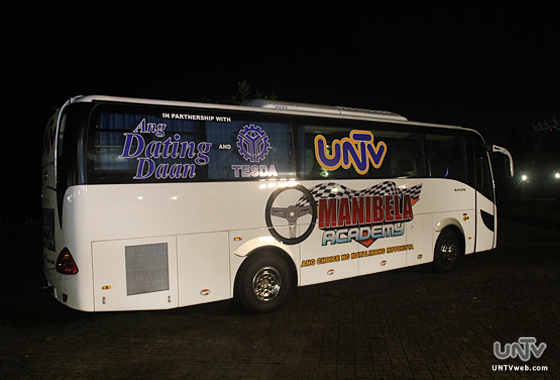
One of the station's latest projects is the Manibela Academy, another first in the Philippines whose aim is to provide mechanical and livelihood training for drivers around the country. TESDA was key partner for this mobile driving school project. The bus will make rounds in barangays to teach drivers the proper and responsible way to drive.  

Manibela Academy bus, the mobile driving project launched by UNTV this month. Photo credit: UNTVweb.com.
Then, UNTV also launched the Infant Care Program for Abandoned Babies project. This charitable project is aimed at providing shelter and care for abandoned and neglected babies. This may also be another helpful advocacy to prevent cases of abortion.

These notable projects by the station are being conducted in partnership with key government offices and non-profit organizations that include the Philippine National Red Cross, Ang Dating Daan's Bro. Eli Soriano, Kamanggagawa Foundation, and more.

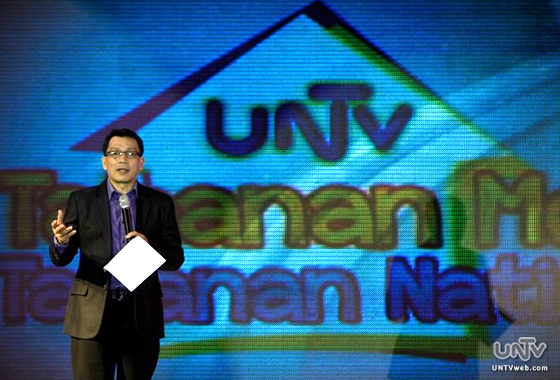
UNTV-BMPI CEO and Chairman, Dr. Daniel Razon delivers his S.O.N.A. or State of the Network Address during the anniversary event at One Esplanade in the Mall of Asia grounds. Photo credit: UNTVweb.com/Photoville International
To that and the bigger public service help to our fellowmen, to the leaders, staff and crews, mabuhay po kayo!

Happy anniversary to UNTV and more power to our "Tahanan Mo, Tahanan Natin!"